
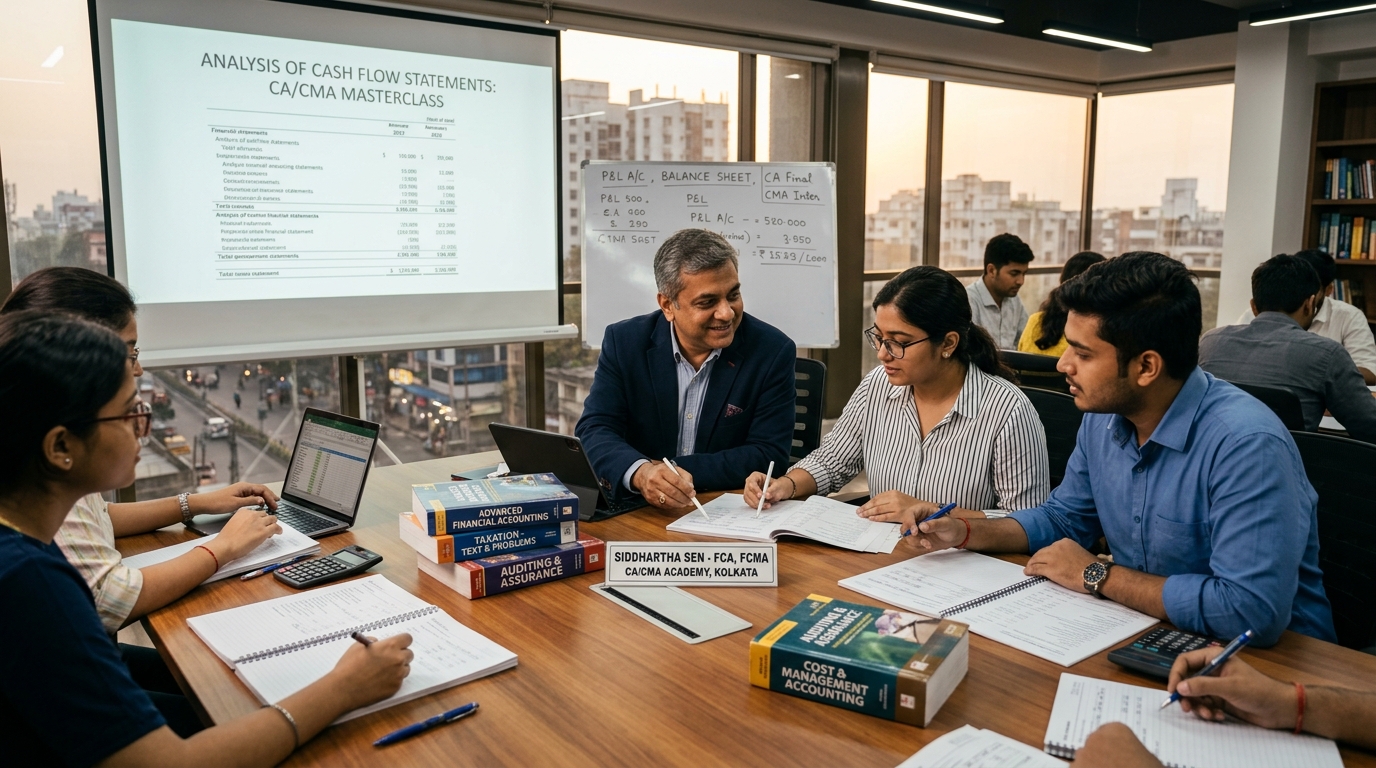
<p data-pm-slice="1 1 []">Financial Accounting preparation often reaches a point where watching more lectures does not solve the problem. You may understand an explanation but still struggle to begin a question independently, handle several adjustments together, or complete your workings accurately. Making progress requires a connection between what you learn in class and what you practise afterwards.</p>
<p>For students searching for <strong>CMA Intermediate Financial Accounting classes in Kolkata</strong>, this connection should guide the choice of coaching. A suitable course should help you understand accounting principles, apply them to different questions, and recognise where your approach needs correction.</p>
<h2>Understand the Transaction Before Applying the Treatment</h2>
<p>An accounting question becomes more manageable when you first understand what has happened. Before writing entries or preparing statements, identify the transaction, the period it relates to, and the accounts it affects.</p>
<p>For example, an amount received does not always represent income earned during the same period. Understanding that distinction is more useful than memorising a treatment without knowing when it applies.</p>
<p>This way of thinking helps you approach questions with purpose. Instead of searching your memory for an identical example, you can work through the information and decide which principles are relevant.</p>
<p>When exploring CMA Intermediate Financial Accounting coaching in Kolkata, look for explanations that make this reasoning clear.</p>
<h2>Follow a Complete Learning Cycle</h2>
<p>A productive study session should include understanding, application, and review. Begin with the concept, study a worked example, and then attempt a similar question without looking at the solution.</p>
<p>Once you finish, compare your approach with the answer. Check the treatment of each adjustment, the figures carried into the workings, and the final presentation. If something is wrong, find the first point where your reasoning or calculation went off track.</p>
<p>This review is where much of the learning happens. Correcting the cause of an error is more valuable than simply replacing an incorrect figure.</p>
<p>Over time, move from familiar questions to those with different wording and combinations of adjustments. This helps you test whether you understand the concept beyond the example used in class.</p>
<h2>Explore the Teaching Approach at Abhimanyyu Agarrwal Classes</h2>
<p>Abhimanyyu Agarrwal Classes describes its teaching philosophy as centred on conceptual clarity, structured learning, and encouraging students to ask questions. Its website highlights a particular focus on CMA Intermediate Accounts and explaining complex concepts through simpler reasoning.</p>
<p>Students considering <strong>CMA Intermediate Financial Accounting classes in Kolkata</strong> can contact the institute to discuss their examination attempt, current preparation, and preferred learning format.</p>
<p>Before enrolling, confirm the exact subject coverage, applicable syllabus, class schedule, and revision arrangements. These details help you determine whether the available batch matches what you need.</p>
<p>Visit the <a href="https://abhimanyyuagarrwal.com/about">About page</a> to learn more about the institute’s stated approach.</p>
<h2>Give Working Notes the Attention They Deserve</h2>
<p>Working notes help organise your reasoning. When a question contains several adjustments, clear workings make it easier to understand where a figure comes from and whether you have included all the relevant information.</p>
<p>Use meaningful labels and keep calculations readable. Avoid placing unrelated calculations together, as this can make checking more difficult.</p>
<p>After completing a question, trace important figures back to their workings. If you cannot quickly explain how you reached an amount, your presentation may need improvement even when the final answer is correct.</p>
<p>Developing this habit during regular practice can also make it easier to review answers during timed sessions.</p>
<h2>Resolve Doubts While the Topic Is Still Fresh</h2>
<p>A doubt left unresolved can affect several later questions. When you are unsure about a treatment, write down the exact step you do not understand and seek clarification.</p>
<p>Specific questions lead to more useful explanations. Asking why an adjustment affects two places is more focused than saying that the entire problem is confusing.</p>
<p>Once the explanation is clear, solve another question using the same principle. This checks whether you can apply what you have learned without relying on the original solution.</p>
<p>Before joining a course, ask how doubts are submitted and answered, particularly if you plan to study through recorded lectures.</p>
<h2>Choose Between Classroom and Online Learning Carefully</h2>
<p>Your learning format should fit your weekly routine and leave time for written practice. Consider travel, other subjects, college or work commitments, and the hours when you can study consistently.</p>
<p>Abhimanyyu Agarrwal Classes states that it offers face-to-face classes in Kolkata alongside online recorded and live learning. Confirm which options are available for the Financial Accounting batch you wish to join.</p>
<p>Classroom learning can provide a fixed attendance routine. Online learning can reduce travel, while recorded access can make it easier to revisit an explanation. Each format still requires active participation and independent practice.</p>
<p>For a digital course, check lecture validity, viewing limits, device requirements, and access to supporting materials before making a payment.</p>
<h2>Keep Earlier Topics Active Through Revision</h2>
<p>Completing a topic once does not mean it will remain easy to recall. Include earlier concepts in your study routine while continuing with new lessons.</p>
<p>A useful revision session can combine a short concept review, one independently attempted question, and a check of previous mistakes. This gives you a clearer picture of what you remember and what needs further work.</p>
<p>As preparation develops, practise mixed questions under a time limit. Review both accuracy and pace. If you take too long, identify whether the delay comes from reading, choosing a method, calculations, or presentation.</p>
<p>Improvement becomes easier when you know which part of the process needs attention.</p>
<h2>Financial Accounting Classes on Chittaranjan Avenue</h2>
<p>Students looking for classroom coaching should consider whether the location is practical for regular attendance.</p>
<p>Abhimanyyu Agarrwal Classes lists its address at <strong>180 A, Chittaranjan Avenue, near Ram Mandir, opposite Miranda House, Kolkata 700007</strong>. Students travelling from CR Avenue, Central Kolkata, MG Road, Girish Park, or other areas can check their route and confirm the classroom arrangements before visiting.</p>
<p>When enquiring, request the current batch timings and fee details. Clarify what is included, such as learning materials, assessments, revision sessions, and doubt support, so that you can make an informed decision.</p>
<h2>Conclusion</h2>
<p>Choosing CMA Intermediate Financial Accounting classes in Kolkata should begin with how you learn and where you need support. Clear explanations matter, but so do opportunities to practise independently, resolve doubts, and revisit difficult concepts.</p>
<p>Abhimanyyu Agarrwal Classes is an option to explore for its stated focus on CMA Intermediate Accounts. Discuss your requirements with the institute and confirm the course details before selecting a batch.</p>
<p>Your preparation should continue beyond understanding a teacher’s solution. Read questions carefully, explain accounting treatments in your own words, maintain clear workings, and learn from recurring mistakes. A consistent routine built around these habits can help you develop a more reliable approach to Financial Accounting.</p>
<p>For current course and batch enquiries, visit <a href="https://abhimanyyuagarrwal.com/contact">Abhimanyyu Agarrwal Classes</a> or call <strong>+91 9874311319</strong>.</p>
Free CA & CMA 2026 Revision Strategy Kit
Download comprehensive chapter-wise formula sheets, accounting adjustments checklists, RTP & MTP solutions, and past ranker answer copies prepared by CA CMA Abhimanyyu Agarrwal.