
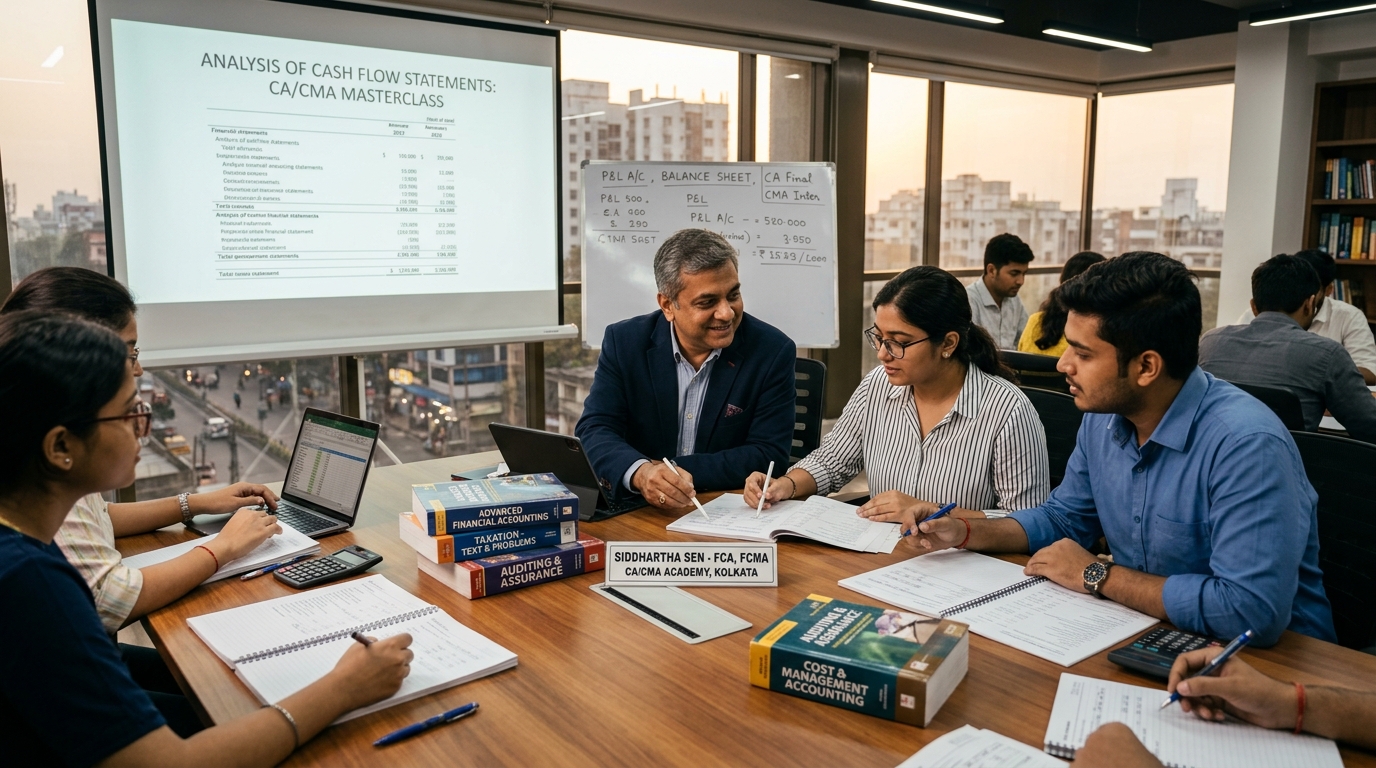
A lot of CA students study regularly but still struggle with consistency, revision, practical application, and maintaining a proper academic routine. The problem is often not a lack of effort. The real issue can be an unstructured schedule, unresolved doubts, irregular practice, or too much dependence on self-paced learning. For students searching for CA offline classes in Kolkata, classroom coaching can provide a more disciplined environment where learning happens according to a fixed schedule and students can stay connected with their preparation more consistently.
Offline CA classes remain relevant even when online and recorded learning options are widely available. The biggest advantage of classroom learning is structure. Students know when they need to attend class, which topics are being covered, and how the syllabus is progressing. This regularity can be useful for students who frequently postpone recorded lectures or find it difficult to maintain the same level of concentration while studying entirely from home.
The Chartered Accountancy course requires different learning approaches at Foundation, Intermediate, and Final levels. At Foundation, students need to build strong fundamentals. At Intermediate, subjects become more application-oriented and require deeper conceptual understanding. At Final, students need advanced knowledge, greater analytical ability, repeated revision, and examination-oriented preparation. ICAI's current course structure also reflects these different academic requirements across the three levels.
One of the strongest academic benefits of CA offline classes in Kolkata is the opportunity for concept-based learning in a dedicated classroom environment. CA subjects cannot be mastered through memorisation alone. Accounting students need to understand why a particular treatment is required. Law students need to understand provisions before attempting to remember them. Taxation requires conceptual clarity together with correct application, while Costing and Financial Management require students to understand the logic behind formulas and calculations.
This becomes especially important in accounting-oriented preparation. A student may understand a practical question while a faculty member is solving it on the board but still struggle when attempting a similar question independently. Classroom teaching should therefore not stop at demonstration. Students need to understand the concept, observe the application, practise the question themselves, identify mistakes, and revise the weak area.
Abhimanyyu Agarrwal Classes has a strong accounting-focused academic presence. The official faculty page currently lists courses such as Accounting (Paper 1) and Advanced Accounting (Paper 1) and states that Abhimanyyu Agarrwal is presently providing offline face-to-face live lectures in Kolkata. This makes the institute particularly relevant for students looking for structured classroom support in accounting-related CA preparation.
Another important advantage of offline learning is direct academic interaction. Students can follow the faculty's explanation in real time, observe how questions are interpreted, and identify difficult areas during the lecture itself. For students who learn better through direct classroom engagement, this can make complicated concepts easier to understand.
However, classroom attendance alone is not enough. Students sometimes make the mistake of assuming that attending every lecture means the subject is fully prepared. In reality, coaching should only be one part of the preparation process. Students still need independent practice, revision, active recall, testing, and self-study.
A stronger preparation cycle is
Classroom Learning → Independent Practice → Revision → Testing → Correction
This process helps convert what students learn in class into actual examination ability.
Revision is particularly important. Students attending regular classes may continue learning new chapters every week without returning to previously completed topics. By the time the syllabus is finished, earlier chapters may already feel unfamiliar. This creates unnecessary pressure close to the examination.
A better system is to combine regular classes with continuous revision. Students can revise recently completed topics every week, return to older chapters periodically, and maintain a list of weak areas that need additional attention. Difficult questions and repeated mistakes should be revisited rather than ignored.
Offline learning can also help students maintain a more disciplined study routine. A physical classroom creates separation between academic time and home distractions. Students who frequently struggle with mobile phones, social media, interruptions, or procrastination may find it easier to concentrate in a structured classroom environment.
At the same time, offline coaching has one major practical challenge: travel. Students should not ignore the amount of time required to reach the classroom and return home. A three-hour class can effectively consume five hours if commuting takes another two hours.
This is why students searching for CA offline classes in Kolkata should calculate the complete daily commitment before joining a batch. The class schedule should leave enough time for practice, revision, other CA subjects, college responsibilities, and rest.
Location can therefore become an important consideration. Students often search for CA classes around CR Avenue, Chittaranjan Avenue, MG Road, Girish Park, Central Kolkata, and North Kolkata because these areas can be accessible through Kolkata's public transport network.
Abhimanyyu Agarrwal Classes lists its Kolkata classroom location at 180A, CR Avenue, Kolkata – 700007, near MG Road Metro Gate No. 1. The official faculty page also confirms that offline face-to-face live lectures are currently provided in Kolkata. This can be convenient for students travelling through CR Avenue, MG Road, Girish Park, and nearby Central or North Kolkata areas.
However, location should not become the first reason for selecting coaching. A nearby class is useful only when the faculty, subject relevance, and teaching method are also suitable.
A better priority is
Faculty → Subject Relevance → Conceptual Teaching → Practice → Revision → Doubt Support → Schedule → Location
Students should also look at the exact subject before enrolling. CA preparation becomes increasingly specialised at Intermediate and Final levels. The current CA Intermediate course includes Advanced Accounting, Corporate and Other Laws, Taxation, Cost and Management Accounting, Auditing and Ethics, and Financial Management and Strategic Management. Students should therefore choose faculty according to the paper they actually need rather than assuming that one teaching style will work equally well for every subject.
The same principle applies to CA Final, where the current papers include Financial Reporting, Advanced Financial Management, Advanced Auditing, Direct Tax, Indirect Tax, and Integrated Business Solutions. At higher levels, subject-specific guidance and independent preparation become even more important.
Another factor students should evaluate is doubt resolution. One unresolved accounting concept or incorrect interpretation can affect several later questions. Students should therefore understand how academic doubts are handled in the classroom and whether there is a practical way to seek clarification when they get stuck during self-study.
Testing should also remain part of offline preparation. Students may understand concepts well during class but struggle with speed, calculation accuracy, recall, or presentation during an examination. Regular tests and examination-style practice help reveal these weaknesses before the actual exam.
Students should also remain connected with official ICAI resources. ICAI continues to provide examination support, revisionary classes, suggested answers, live classes, and other academic resources for students at different CA levels and attempts. Private coaching should complement these resources rather than completely replace them.
Students comparing CA offline classes fees in Kolkata should also consider the complete academic and practical cost. The class fee is only one part of the decision. Travel expenses, study material, class schedule, revision support, and the amount of self-study time available should also be considered.
The lowest-priced class is not automatically the best value, and a higher fee does not automatically guarantee better teaching. Students should focus on whether the class actually supports their preparation needs.
Another common mistake is joining too many classes or collecting too many resources. More lectures do not necessarily mean stronger preparation. CA students need enough time to process what they have learned, practise questions, revise concepts, and test themselves. A balanced routine is more useful than a timetable filled entirely with coaching.
Students considering Abhimanyyu Agarrwal Classes can review the official faculty information, available courses, free resources, blog content, and contact details before making a decision. The current public information clearly establishes offline face-to-face teaching in Kolkata and accounting-related courses such as Accounting and Advanced Accounting, but students should verify the exact course, examination attempt, batch schedule, current fee, and availability directly before enrolling.
The real purpose of offline CA coaching should not simply be to create regular attendance. It should create an academic environment where students understand concepts properly, receive structured guidance, practise independently, revise consistently, and gradually become capable of handling examination questions without relying continuously on the faculty.
Conclusion:
CA offline classes in Kolkata can be a practical choice for students who need fixed schedules, face-to-face teaching, classroom discipline, and a more structured academic routine. The real benefit of offline coaching comes when classroom learning is combined with independent practice, regular revision, doubt resolution, testing, and disciplined self-study. Students should compare faculty, subject relevance, teaching methodology, class schedule, travel time, location, and fees before enrolling. Students exploring Abhimanyyu Agarrwal Classes can consider its verified offline face-to-face teaching in Kolkata and accounting-focused offerings, including Accounting and Advanced Accounting, while confirming the latest batch and course details directly. The right offline CA classes should ultimately help students move beyond regular attendance and develop the ability to understand concepts, practise independently, revise systematically, and prepare with greater confidence for CA examinations.
Free CA & CMA 2026 Revision Strategy Kit
Download comprehensive chapter-wise formula sheets, accounting adjustments checklists, RTP & MTP solutions, and past ranker answer copies prepared by CA CMA Abhimanyyu Agarrwal.