
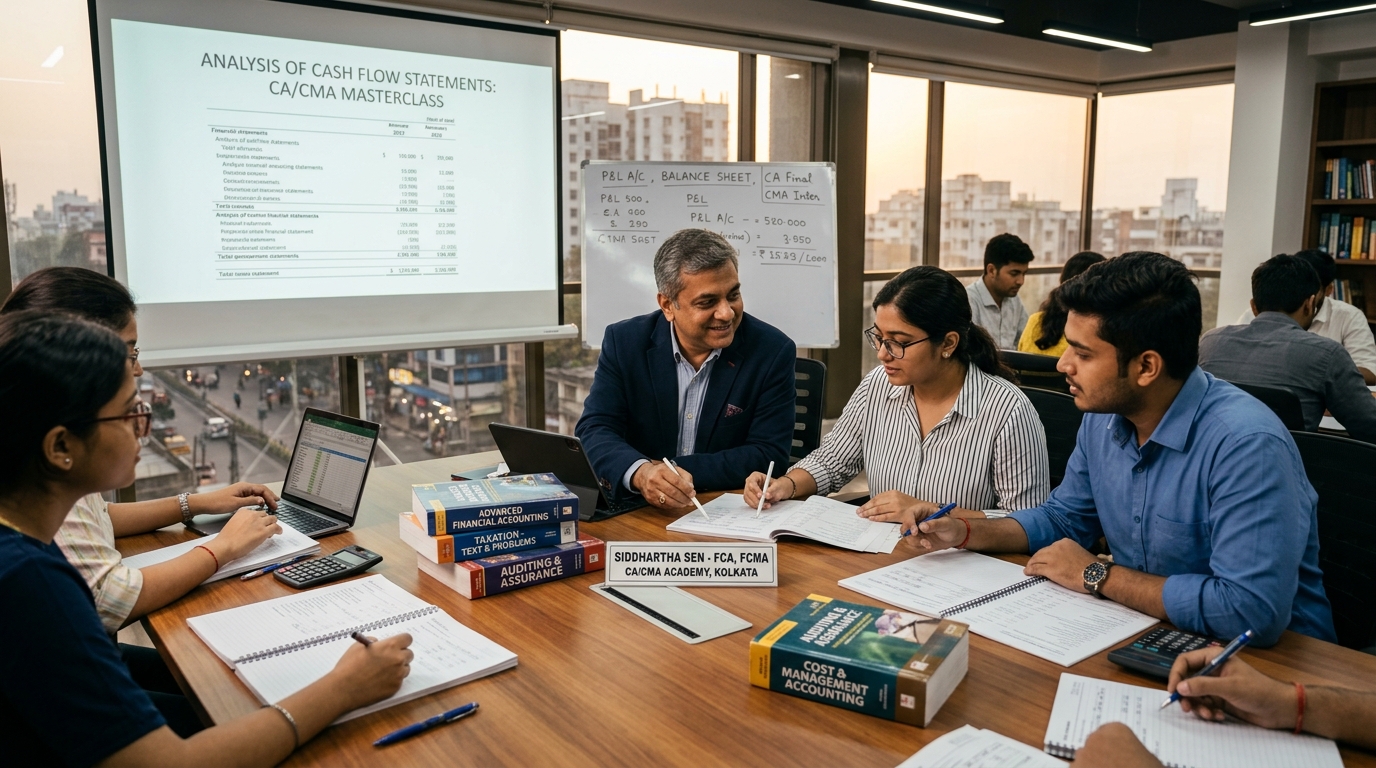
Students searching for CA Foundation Paper 1 Accounting classes in Kolkata are usually looking for more than a faculty member who can finish the syllabus.
They need someone who can help them understand Accounting from the basics, apply concepts to unfamiliar questions, correct mistakes and eventually solve Paper 1 independently under examination conditions.
Under ICAI’s current CA Foundation structure, the four papers are
- Paper 1 – Accounting
- Paper 2 – Business Laws
- Paper 3 – Quantitative Aptitude
- Paper 4 – Business Economics
Accounting is therefore officially Paper 1 of CA Foundation.
ICAI currently provides Paper 1 study material applicable from the May 2026 examination onward, so students should make sure that the class they choose follows the material applicable to their intended examination attempt.
The goal of a good Accounting class should be simple
Understand the concept → Apply it → Practise it → Correct mistakes → Revise → Perform under time pressure.
If a course stops at lecture completion, the student’s preparation is incomplete.
Why Paper 1 Accounting Is Important in CA Foundation
Accounting is one of the main practical subjects at Foundation level.
It requires students to understand how financial transactions are
- Identified
- Recorded
- Classified
- Adjusted
- Summarised
- Presented
The subject is not about memorising dozens of journal entries.
Students must develop the ability to look at a transaction and decide
- What happened?
- Which accounts are affected?
- Which Accounting principle applies?
- What should be debited?
- What should be credited?
- Which working is required?
- How should the final answer be presented?
A student who develops this thinking process at Foundation level creates a much stronger base for higher-level Accounting.
What Does CA Foundation Paper 1 Accounting Cover?
ICAI’s current Paper 1 material begins with the theoretical framework of Accounting and progresses through the Accounting process and major practical areas.
Students preparing for Paper 1 should therefore expect to study a broad range of topics.
- Theoretical Framework
Students first need clarity regarding basic Accounting concepts.
This includes areas such as
- Meaning and scope of Accounting
- Accounting concepts
- Accounting principles
- Accounting conventions
- Capital and revenue items
- Accounting policies
- Accounting estimates
- Fundamental assumptions
Students sometimes ignore these chapters because they appear theoretical.
That is a mistake.
The practical treatment used in Accounting comes from underlying principles.
If the principle is clear, the treatment becomes easier to understand.
- Accounting Process
The Accounting process forms the foundation of the subject.
Students should become comfortable with
- Journal entries
- Ledger accounts
- Trial balance
- Subsidiary books
- Cash book
- Rectification of errors
These topics should not be treated as something a Commerce student automatically knows.
Weakness here affects later chapters.
Journal Entries
Students should avoid memorising entries without understanding them.
Instead, follow this process.
Step 1: Understand the Transaction
What actually happened?
Step 2: Identify the Accounts
Which accounts changed because of the transaction?
Step 3: Understand the Effect
Did an asset increase?
Did an expense arise?
Did a liability increase?
Did income arise?
Step 4: Pass the Entry
Only after understanding the effect should you determine the debit and credit.
This method creates stronger long-term understanding than memorising entries individually.
- Ledger and Trial Balance
Students should understand the complete Accounting flow
Transaction → Journal → Ledger → Trial Balance → Financial Statements
If students learn each stage separately without understanding how they connect, Accounting starts feeling like a collection of unrelated formats.
A good faculty should show how an entry eventually affects the final financial statements.
- Bank Reconciliation Statement
Bank Reconciliation Statement is a chapter where students often memorise
Add this item. Deduct that item.
That method is unreliable.
Instead, understand
- Which balance is given?
- Which transaction has been recorded?
- Which transaction has not yet been recorded?
- Which book reflects the transaction?
- What adjustment will reconcile the two balances?
Understanding direction is more reliable than memorising plus-and-minus rules.
- Inventories
Students should understand
- Why inventories are valued
- How valuation influences financial statements
- Which costs are relevant
- How different information affects the final amount
The purpose should be understanding the treatment rather than remembering one fixed numerical pattern.
- Depreciation and Amortisation
Students should be able to identify
- Which asset is involved
- When it was purchased
- Whether it was sold
- Which depreciation method applies
- Which period must be considered
- How depreciation affects the accounts
Careless reading of dates can cause unnecessary calculation errors.
- Final Accounts
Final Accounts combines several earlier concepts.
Students may face multiple adjustments in a single question.
The real skill is identifying the effect of each adjustment.
For every adjustment, ask
Effect 1: Where does it affect income or expenditure?
Effect 2: Where does it affect the financial position?
This approach helps students avoid missing the second effect of an adjustment.
- Not-for-Profit Organisation Accounts
Students should understand the purpose and Accounting treatment used for not-for-profit organisations rather than merely memorising formats.
Focus on the relationship between
- Receipts
- Payments
- Income
- Expenditure
- Assets
- Liabilities
- Accounts From Incomplete Records
Incomplete-record questions test whether students can reconstruct missing information logically.
Students need
- Strong Accounting relationships
- Organised working notes
- Careful interpretation
- Step-by-step calculations
These questions reward logical reconstruction rather than memorisation.
- Partnership Accounts
Partnership is often one of the more intimidating parts of Foundation Accounting.
The wrong approach is trying to learn the entire chapter in one massive format.
Break it down.
Start With Partnership Fundamentals
Understand
- Capital accounts
- Profit-sharing arrangements
- Partner transactions
- Basic adjustments
- Then Move to Goodwill
Understand when goodwill becomes relevant and how it affects partners.
Then Study Reconstitution
Prepare topics such as
- Admission
- Retirement
- Death
- Change in profit-sharing arrangements
- Finally Study Dissolution
Understand the sequence in which
- Assets are realised
- Liabilities are settled
- Partner balances are adjusted
Complex partnership questions become easier when smaller concepts are clear first.
- Company Accounts
Company Accounts introduces students to transactions relating to corporate capital and securities.
Students should focus on
- Understanding the transaction
- Identifying the Accounting effect
- Passing the correct entries
- Preparing supporting calculations
- Presenting the final answer properly
ICAI includes company-accounting material within the current Paper 1 Accounting syllabus.
Who Should Consider CA Foundation Paper 1 Accounting Coaching?
Not every student needs the same type of class.
Non-Commerce Students
Students from Science, Humanities or another non-Commerce background may need additional support in:
- Accounting terminology
- Debit and credit
- Journal entries
- Ledger posting
- Trial balance
- Financial statements
A Foundation course should genuinely teach fundamentals rather than assume previous Accountancy knowledge.
Commerce Students With Weak Basics
Some Commerce students have studied Accountancy for years but still struggle to apply concepts independently.
Signs of weak fundamentals include
- Forgetting journal entries
- Confusion about adjustments
- Dependence on formats
- Difficulty solving new questions
- Repeated calculation errors
- Fear of Partnership or Company Accounts
These weaknesses should be addressed early.
Students Who Understand in Class but Cannot Solve at Home
This is one of the most common Accounting problems.
The student understands the faculty’s solution but cannot reproduce the method independently.
That generally means the preparation is too passive.
The correction is straightforward
Reduce watching. Increase solving.
Students Repeating CA Foundation
A repeater should first analyse the previous attempt.
Ask
- Was the syllabus completed?
- Were concepts clear?
- How many questions were solved independently?
- Was revision completed?
- Were mock papers attempted?
- Was time management poor?
- Were too many questions left incomplete?
- Were mistakes conceptual or careless?
The new preparation system should solve the actual problem rather than simply repeat the previous approach.
What Should Good CA Foundation Paper 1 Accounting Classes Provide?
- Teaching From Concept to Application
A strong faculty should explain
- Why a treatment is required
- Why an entry is passed
- Why an adjustment has multiple effects
- Why one method is correct
- Why another method is incorrect
Students should understand rather than memorise.
- Current Paper 1 Coverage
Students should verify that their class follows the Accounting material applicable to their examination attempt.
ICAI currently identifies Paper 1 study material applicable from May 2026 onward and also maintains Paper 1 resources under the New Scheme.
Do not purchase old recorded lectures simply because they are inexpensive.
Check applicability first.
- Progressive Question Practice
The sequence should ideally be
Basic Question → Standard Question → Adjustment Question → Mixed Question → Examination-Level Question
Students should not remain dependent on one standard illustration.
- Written Homework
Accounting requires written practice.
After every important concept, students should solve questions without looking at the answer first.
The faculty completing questions in class is not enough.
The student must complete questions independently.
- Doubt Resolution
Before joining, ask how doubts are resolved.
Possible systems include
- In-class doubts
- Post-class discussion
- Separate doubt sessions
- Online support
- Written question submission
- Revision doubt sessions
Students should know the actual process.
- Chapter Tests
Chapter-wise testing helps students determine whether they have really learned the topic.
A test should identify
- Concept mistakes
- Calculation errors
- Wrong entries
- Missed adjustments
- Poor workings
- Weak presentation
- Cumulative Tests
Students should also be tested on previously completed chapters.
Otherwise
Chapter finished → Chapter forgotten
becomes the normal cycle.
- Full-Paper Practice
ICAI maintains Foundation question papers for recent examination terms, including Paper 1 Accounting.
Students should eventually practise complete examination-style papers to test
- Accuracy
- Speed
- Time allocation
- Question selection
- Presentation
- Stamina
Full-paper practice should not be left until the final few days.
How to Judge an Accounting Faculty
A demo lecture can help, but students need to evaluate the right things.
Do not judge only
- Personality
- Social-media popularity
- Promotional videos
- Number of followers
- Number of books
- Number of lecture hours
Instead, evaluate whether the faculty
- Explains why an entry is passed
- Connects concepts with questions
- Uses clear working notes
- Maintains an understandable speed
- Identifies common mistakes
- Gives students independent practice
- Handles doubts properly
- Discusses examination presentation
The best test comes after the demo.
Take a similar question.
Close the notes.
Try solving it.
If you can understand how to begin, the explanation probably helped.
Offline CA Foundation Paper 1 Accounting Classes in Kolkata
Offline classes may suit students who
- Need classroom discipline
- Prefer direct faculty interaction
- Ask frequent doubts
- Struggle with recorded classes
- Need a fixed routine
However, location matters.
Students should calculate
- Home-to-classroom travel
- Return travel
- Metro or bus waiting time
- College-to-classroom travel
- Time left for homework
- Time left for other Foundation papers
A two-hour class that requires several additional hours of daily travel may become difficult to sustain.
Online CA Foundation Paper 1 Accounting Classes
Online classes may suit students who
- Live outside Central Kolkata
- Attend college
- Want to avoid daily travel
- Need greater flexibility
- Can follow a fixed online schedule
Students should confirm
- Whether classes are live
- Whether recordings are available
- Whether doubts can be submitted
- Whether tests are included
- Whether revision support is provided
Online Accounting still requires offline written practice.
Recorded Accounting Classes
Recorded classes provide flexibility but require discipline.
A typical backlog starts small
2 pending lectures → 5 pending lectures → 10 pending lectures → entire chapter pending
Avoid this.
Set a rule
Do not allow the lecture backlog to grow continuously.
If backlog develops
- Maintain the current topic.
- Clear one pending lecture at a time.
- Continue question practice.
- Do not replace solving with binge-watching lectures.
Watching ten lectures without solving questions does not equal ten productive study sessions.
A Practical Paper 1 Study Cycle
Use the following six-step system for every chapter.
Step 1 — Understand
Learn the concept through class and current material.
Step 2 — Observe
Follow solved illustrations carefully.
Step 3 — Solve
Attempt similar questions without assistance.
Step 4 — Correct
Identify the exact reason for every mistake.
Step 5 — Reattempt
Return to difficult questions after several days.
Step 6 — Test
Attempt the concept under time pressure.
This cycle converts lecture knowledge into examination ability.
The 24-Hour Accounting Rule
After every major Accounting lecture, complete at least some written practice within 24 hours.
A simple routine
- Review the concept.
- Close the notes.
- Attempt one or more questions.
- Check the solution.
- Identify errors.
- Rewrite the incorrect portion.
- Record recurring mistakes.
Waiting a week before practising greatly increases the amount you need to relearn.
Maintain a Paper 1 Mistake Notebook
Students should record important mistakes.
Example
- Chapter: Final Accounts
- Mistake: Forgot the Balance Sheet effect of outstanding expenses
- Reason: Considered only the expense adjustment
- Correct Approach: Adjust expense and recognise the outstanding liability
- Reattempt: Correct after three days
Other mistakes may include
- Wrong debit or credit
- Missed adjustment
- Incorrect classification
- Sign error
- Wrong calculation
- Missing working note
- Incorrect format
- Misreading the question
- Poor time allocation
Before mock papers, revise this notebook.
Your own repeated mistakes are high-value revision material.
A Weekly CA Foundation Paper 1 Routine
During the Week
After Accounting classes
- Revise the concept briefly
- Solve 1–3 questions
- Update your doubt list
- Update the mistake notebook
- Weekend
Complete
- One recent-chapter revision
- One old-chapter revision
- Mixed question practice
- One timed exercise
- Every Few Weeks
Attempt a cumulative test covering multiple completed chapters.
This prevents students from forgetting early topics while learning later chapters.
How to Use ICAI Resources
ICAI currently provides Paper 1 Accounting study material for the applicable Foundation syllabus and maintains question papers for recent attempts.
A sensible resource sequence is
Faculty Explanation → Class Illustrations → Homework → ICAI Material → Previous Questions → Mock Test → Revision
Avoid collecting too many random notes.
A smaller set of reliable resources used thoroughly is generally more useful than dozens of untouched PDFs.
CA Foundation Paper 1 Accounting at Abhimanyyu Agarrwal Classes
The Abhimanyyu Agarrwal Classes website currently lists a course specifically titled “CA Foundation Paper 1 Accounting.”
That direct course alignment makes it relevant for students searching specifically for CA Foundation Paper 1 Accounting classes in Kolkata.
Before enrolling, students should verify the current
- Examination attempt
- Batch start date
- Teaching mode
- Faculty
- Lecture schedule
- Course validity
- Study material
- Tests
- Doubt support
- Revision support
- Current fee
Current commercial and batch details may change, so students should confirm them directly before payment.
Location for Kolkata Students
The institute’s current contact page lists
180A, CR Avenue, Kolkata – 700007
The location is described as near Ram Mandir, opposite Miranda House Play School, next to Shyam Market, with MG Road Gate No. 1 given as the metro reference.
This location may be relevant for students searching for
- CA Foundation Paper 1 Accounting classes near CR Avenue
- CA Foundation Accounting classes near MG Road
- CA Foundation Accounting classes in Central Kolkata
- CA Foundation Accounting classes accessible from Girish Park
- CA Foundation Accounting classes accessible from North Kolkata
Students choosing offline coaching should calculate their actual door-to-door travel time before enrolling.
- 15 Questions to Ask Before Joining
- Is this specifically CA Foundation Paper 1 Accounting?
- Which examination attempt is covered?
- Is the course based on the currently applicable ICAI material?
- Who conducts the regular classes?
- Is a demo lecture available?
- Does teaching begin with Accounting fundamentals?
- How many classes are conducted each week?
- When will the syllabus be completed?
- Is written homework provided?
- Are chapter tests conducted?
- Are tests evaluated?
- How are doubts resolved?
- Are revision classes included?
- Are backup recordings available?
- What exactly does the course fee include?
Clear answers to these questions are more useful than vague claims such as “best Accounting coaching.”
Frequently Asked Questions
Is Accounting Paper 1 in CA Foundation?
Yes. ICAI officially lists Accounting as Paper 1 of the current CA Foundation course.
Which CA Foundation Paper 1 study material is currently applicable?
ICAI currently publishes Paper 1 Accounting study material applicable from the May 2026 examination onward. Students should verify the material applicable to their own examination attempt.
Which are the best CA Foundation Paper 1 Accounting classes in Kolkata?
There is no universally best class. Students should compare faculty expertise, concept explanation, current syllabus coverage, written practice, evaluated tests, doubt support, revision planning and learning mode.
Can a non-Commerce student study CA Foundation Paper 1 Accounting?
Yes. A non-Commerce student may need additional time initially for Accounting terminology, debit-credit rules, journal entries, ledgers and trial balance, but these concepts can be learned systematically.
Are offline Accounting classes better?
Not automatically. Offline classes provide structure and direct interaction. Online and recorded courses provide flexibility. The correct mode depends on the student’s discipline, location and schedule.
Is watching Accounting lectures enough?
No. Accounting is a practical subject. Students need independent written question practice, error correction and timed examination preparation.
Should students solve ICAI Paper 1 question papers?
Yes. ICAI publishes Paper 1 Accounting question papers for recent Foundation examination terms, making them useful for examination-level practice after students have developed the necessary concepts.
Should I take subject-wise Accounting coaching?
Subject-wise coaching may be suitable when Accounting requires specialised support and the student has a separate plan for Business Laws, Quantitative Aptitude and Business Economics.
Where is Abhimanyyu Agarrwal Classes located?
The website currently lists its classroom at 180A, CR Avenue, Kolkata – 700007, with MG Road Gate No. 1 given as the metro reference.
Does Abhimanyyu Agarrwal Classes offer CA Foundation Paper 1 Accounting?
The website currently lists a course named CA Foundation Paper 1 Accounting. Students should verify the active batch, examination attempt, learning mode and current course conditions before enrolling.
Conclusion
Students searching for CA Foundation Paper 1 Accounting classes in Kolkata should not judge a course only by its fees, lecture duration or promotional claims.
Paper 1 preparation should help students develop
- Strong Accounting fundamentals
- Debit-credit clarity
- Correct journal treatment
- Logical adjustment handling
- Structured working notes
- Independent problem-solving
- Regular written practice
- Effective doubt resolution
- Evaluated testing
- Repeated revision
- Examination-level speed and accuracy
ICAI officially identifies the subject as CA Foundation Paper 1: Accounting, with current study material applicable from the May 2026 examination onward.
Abhimanyyu Agarrwal Classes currently lists a dedicated CA Foundation Paper 1 Accounting course, and its Kolkata classroom is listed at CR Avenue near MG Road Gate No. 1.
The strongest preparation strategy is not complicated
Learn → Solve → Check → Correct → Reattempt → Revise → Test
Accounting improves when students stop being spectators and start solving.
Suggested CTA
Looking for CA Foundation Paper 1 Accounting Classes in Kolkata?
Build your Paper 1 concepts through structured Accounting preparation and regular written practice.
Check the current examination attempt, batch schedule, teaching mode, course validity, tests and doubt-support options before enrolling.
- CTA Button: Explore Paper 1 Accounting
- CTA Button: View Faculty
- CTA Button: Enquire About Current Batch
- Internal Linking Suggestions
- CA Foundation Accounting classes in Kolkata → Main Paper 1 topic page
- CA Foundation Accounts classes in Kolkata → Same main Accounting cluster
- CA Foundation classes in Kolkata → Overall Foundation guide
- Best CA Foundation classes in Kolkata → Comparison article
- CA CMA classes in Kolkata → Main CA/CMA hub
- CA Foundation Accounting classes near CR Avenue → Local article
- CA Foundation Accounting classes near MG Road → Local article
- CA Inter Advanced Accounting classes in Kolkata → Next-level Accounting article
- Faculty → /faculty
- Free Resources → /freeresources
- Blog → /bloglist
- Contact → /contact
- SEO Recommendation
This keyword is excellent for the same Paper 1 Accounting topic cluster, but there is substantial overlap with:
- CA Foundation Accounting classes in Kolkata
- CA Foundation Accounts classes in Kolkata
- CA Foundation Financial Accounting classes in Kolkata
- CA Foundation Paper 1 Accounting classes in Kolkata
The safest strategy is to make “CA Foundation Accounting classes in Kolkata” the main canonical page and use “CA Foundation Paper 1 Accounting classes in Kolkata” prominently as an exact-paper secondary variation.
If you publish this as a separate article, it must retain this Paper 1 preparation-roadmap angle and internally link strongly to the main Accounting page. Do not publish four articles with only the keyword changed.
Free CA & CMA 2026 Revision Strategy Kit
Download comprehensive chapter-wise formula sheets, accounting adjustments checklists, RTP & MTP solutions, and past ranker answer copies prepared by CA CMA Abhimanyyu Agarrwal.