
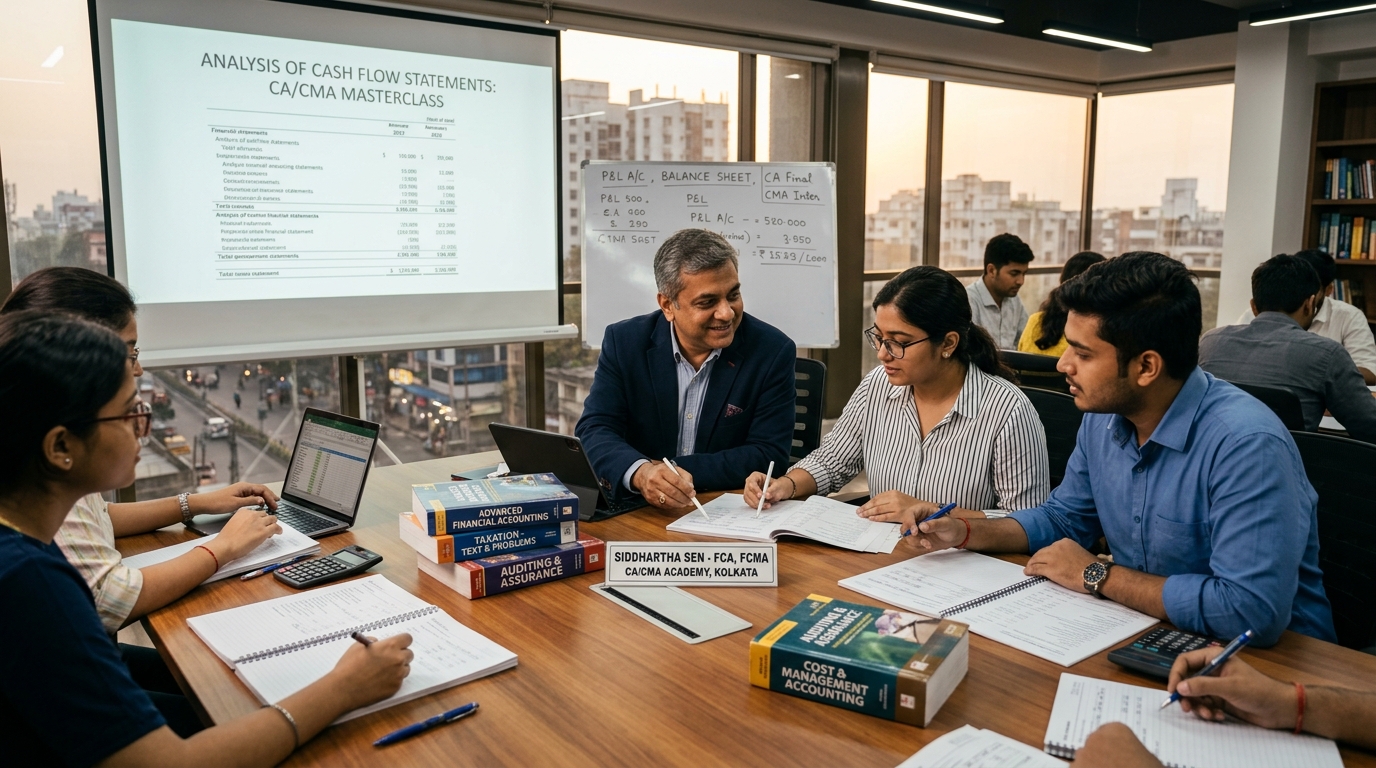
CA Final students often have to manage far more than lectures. Along with a demanding syllabus, they need time for practical questions, revision, case-study preparation, mock tests, amendments, and repeated self-study. Many students also need to balance professional responsibilities or other commitments. For students searching for CA Final online classes in Kolkata, online learning can provide the flexibility needed to organise these different parts of preparation more effectively.
Online classes can reduce travelling time and allow students to study from home, but flexibility alone does not guarantee good preparation. CA Final requires discipline, conceptual clarity, regular application, and repeated revision. A strong online learning system should therefore help students understand difficult topics, practise independently, manage lecture progress, and prepare according to the requirements of their examination attempt.
Under the current ICAI Final structure, students prepare six papers: Financial Reporting, Advanced Financial Management, Advanced Auditing, Assurance and Professional Ethics, Direct Tax Laws and International Taxation, Indirect Tax Laws, and Integrated Business Solutions. ICAI's examination and study resources continue to reflect these six papers. Each subject requires a different preparation method, so students should evaluate online classes paper by paper rather than treating the entire CA Final course as one uniform programme.
One of the biggest advantages of CA Final online classes in Kolkata is the time students can save on commuting. A classroom lecture may require additional travel before and after class. For students travelling across Kolkata, that can consume several hours every week. Online learning allows that time to be redirected towards practical questions, revision, mock tests, or rest, provided the student uses the saved time productively.
Flexibility is especially useful for students whose schedules are not identical every day. Recorded or online learning can allow students to plan lectures around other responsibilities instead of reorganising their entire day around classroom timings. However, this flexibility also creates one of the biggest risks of online CA Final preparation: procrastination. A lecture that can be watched “later” can quickly become part of a large backlog if the student does not maintain a strict study timetable.
Financial Reporting is one subject where online learning needs to remain highly application-focused. The paper requires students to understand advanced accounting and reporting concepts and then apply them correctly in questions. ICAI's current November 2026 revision programme includes dedicated Financial Reporting sessions on areas such as accounting and reporting of financial instruments, showing the technical depth involved. Students should therefore choose online learning that explains the reasoning behind treatments instead of simply providing completed solutions to copy.
Advanced Financial Management requires another type of preparation. Students need to understand financial concepts, formula logic, calculations, and analytical applications. ICAI's current revision programme includes areas such as Portfolio Management for Advanced Financial Management. A useful online course should therefore help students understand when and why a formula applies and then provide enough opportunity to practise different question variations independently.
Advanced Auditing, Assurance and Professional Ethics requires a stronger combination of understanding, retention, technical terminology, and answer presentation. ICAI's November 2026 revisionary programme includes Professional Ethics and liabilities of auditors among its focused areas. Online students should avoid simply watching Audit lectures continuously. After each topic, they should practise active recall and test whether they can reproduce the important concepts without immediately looking at their notes.
Direct Tax Laws and International Taxation require particularly careful attempt-specific preparation. Students need to understand provisions, practise application, revise regularly, and remain aligned with the material relevant to their examination. ICAI's May 2026 applicable-material document separately identifies the relevant Direct Tax study material, RTP, and judicial updates for that attempt. This shows why students should check whether an online course has been designed or updated for their specific CA Final attempt.
Indirect Tax Laws requires similar discipline. Students need conceptual clarity in GST-related areas as well as repeated application through questions. ICAI's current revision sessions include areas such as supply under GST, charge of GST, and place of supply. Students selecting CA Final online coaching classes in Kolkata should therefore ensure that the course includes current and attempt-relevant content rather than relying on old recordings without verified updates.
Integrated Business Solutions requires a different approach because students need to work with multidisciplinary case-study situations. This paper cannot be prepared effectively by memorising isolated concepts. ICAI's applicable material for Paper 6 draws on core Final papers, SPOM material, and case-study digests. Students should therefore look for online learning that supports analytical thinking, integration of concepts, and case-based application.
Another important decision is whether to choose live online classes or recorded classes. Live online CA Final classes provide a fixed schedule and stronger external discipline. Students know when lectures will happen, which can reduce procrastination. Recorded classes provide greater flexibility and allow students to pause, replay, or revisit difficult portions. The right choice depends on the student's study habits.
Students who repeatedly delay self-paced lectures may benefit from scheduled live classes. Students who have changing professional or academic commitments may find recorded classes more practical. The mistake is assuming that one format is universally better. The right mode is the one the student can follow consistently for several months.
Online students should also check the lecture-access conditions before purchasing a course. Important points include course validity, number of views, supported devices, playback restrictions, lecture availability, and whether updates are included. A course may look affordable initially but become inconvenient if the access period is too short or if its technical restrictions do not suit the student's study routine.
Doubt support is another major factor. Online learning does not automatically mean students will receive direct access to the faculty whenever they have a problem. Before joining, students should understand how doubts are handled. There may be scheduled doubt sessions, messaging support, discussion groups, or another system. The important question is whether students can realistically get help when they cannot understand a concept or question.
Revision becomes even more important in online learning because students can easily fall into the habit of continuously consuming new lectures. Completing videos creates a visible sense of progress, but examination performance depends on retention and application. Students should therefore maintain a preparation cycle such as:
Learn → Practise → Revise → Test → Correct → Re-test
A chapter should not be considered complete simply because all its videos have been watched.
Students should also create a weekly revision system. For example, new lectures can be completed during selected days, while other periods are reserved for question practice, theory recall, old-topic revision, and testing. This prevents online learning from becoming an endless lecture-completion exercise.
Mock testing should also remain part of the preparation. ICAI continues to use Mock Test Paper programmes as an important support mechanism for CA Final students; for May 2026, two series were conducted across the Final papers. Online students should use timed testing to check whether the flexibility of home-based preparation is actually translating into examination readiness.
The official ICAI Board of Studies also provides structured online learning support. Current ICAI announcements include Live Virtual Classes for CA Final students appearing in May 2027 and November 2027 and separate Live Virtual Revisionary Classes for students appearing in November 2026. This gives students an additional official learning resource that can be used alongside private coaching and self-study.
For Kolkata students, online learning can also solve a practical location problem. Students from CR Avenue, Chittaranjan Avenue, MG Road, Girish Park, Central Kolkata, North Kolkata, or other parts of the city do not need to select faculty only on the basis of travelling convenience. Online learning allows the academic decision to focus more strongly on faculty, subject relevance, teaching style, and course applicability.
However, location can still matter for students who want occasional access to an institute, additional resources, or the option of switching between online and classroom formats. Students exploring Abhimanyyu Agarrwal Classes should review the official website and current course listings to understand which CA Final-related digital learning options, if any, are presently available. The availability of a specific CA Final paper should be verified directly rather than assumed.
Students comparing CA Final online classes fees in Kolkata should also look beyond the price displayed on the course page. They should check what the fee actually includes: faculty access, recorded or live lectures, course validity, materials, amendments, doubt solving, revision resources, tests, and technical access conditions. The cheapest course is not automatically the best value, while a higher-priced course is not automatically academically stronger.
One of the most common online-learning mistakes is buying multiple courses for the same subject. Students sometimes believe that having lectures from several faculties will improve preparation. In practice, this can create duplication and reduce revision time. It is usually more productive to choose one dependable primary resource, complete it properly, practise enough questions, and revise repeatedly.
A simple online CA Final preparation system can be built around four areas: structured lectures, independent practice, continuous revision, and testing. The lectures provide explanation. Practice converts the explanation into application. Revision develops retention. Testing shows whether the preparation works under time pressure.
Students should also track their backlog honestly. A small pending lecture list should be cleared quickly rather than allowed to grow for weeks. At the same time, students should not respond to backlog by watching excessive lectures in one day while completely ignoring practice. The aim is to restore balance, not simply increase video consumption.
The real advantage of online learning is control. Students can control when they learn, how often they replay difficult concepts, and how they arrange their study day. But that control only becomes useful when combined with discipline. Without a timetable, revision plan, and self-testing routine, flexibility can easily turn into inconsistency.
Students considering Abhimanyyu Agarrwal Classes while searching for CA Final online learning should review the official faculty, course, free-resource, blog, and contact sections and confirm current CA Final course availability directly. Before enrolling, they should verify the specific paper, faculty, examination attempt, delivery mode, course validity, fees, amendments, and doubt support.
Conclusion:
CA Final online classes in Kolkata can provide a flexible and efficient learning option for students who need to balance advanced CA preparation with other responsibilities. By reducing travel and providing access to live or recorded learning, online classes can leave more time for practice, revision, case-study preparation, and testing. However, flexibility must be supported by discipline. Students should choose courses based on faculty, subject relevance, examination-attempt applicability, lecture access, revision support, doubt resolution, and practical learning—not simply convenience or price. Those exploring Abhimanyyu Agarrwal Classes should verify the current availability of the required CA Final online course directly from the official website. The right online preparation should ultimately help students move beyond watching lectures and develop the ability to understand, apply, revise, test, and perform independently in the CA Final examination.
Free CA & CMA 2026 Revision Strategy Kit
Download comprehensive chapter-wise formula sheets, accounting adjustments checklists, RTP & MTP solutions, and past ranker answer copies prepared by CA CMA Abhimanyyu Agarrwal.