
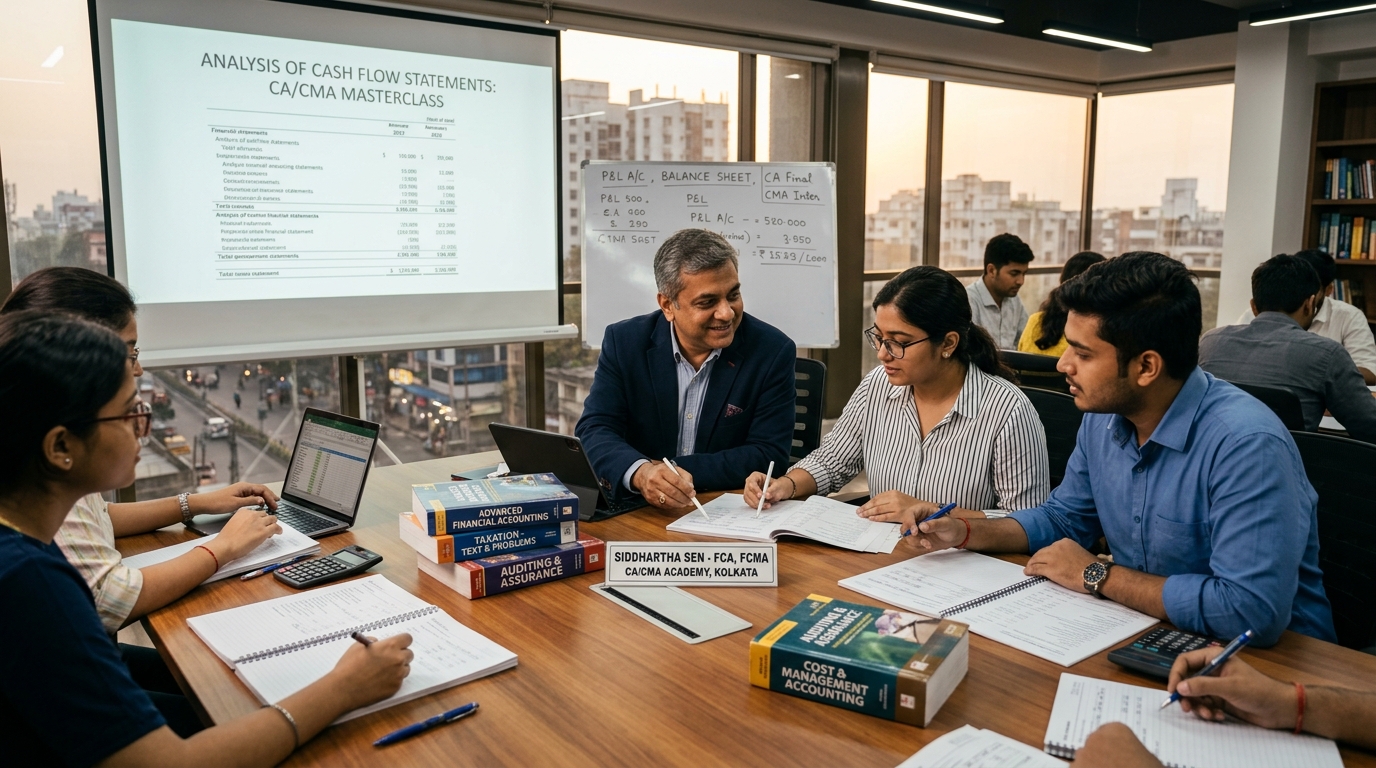
CA Final is the stage where students need more than regular study hours. The syllabus demands advanced conceptual understanding, application, consistent revision, case-based thinking, and the ability to manage several technically demanding papers together. For students searching for CA Final classes in Kolkata, the real requirement is therefore not simply finding coaching. It is finding a preparation system that helps convert a large syllabus into a structured and manageable study plan.
Under the current ICAI course structure, CA Final consists of six papers across two groups: Financial Reporting, Advanced Financial Management, Advanced Auditing, Assurance and Professional Ethics, Direct Tax Laws and International Taxation, Indirect Tax Laws, and Integrated Business Solutions. Each paper tests a different combination of conceptual knowledge, application, interpretation, professional judgement, and examination technique. This makes subject-wise preparation especially important at the Final level.
One of the biggest challenges for CA Final students is the depth of the syllabus. At this stage, students cannot depend only on memorised formats or repeated reading. Financial Reporting requires strong understanding of advanced reporting concepts, while Advanced Financial Management demands numerical application and analytical thinking. Audit requires technical understanding and structured presentation, while taxation papers require students to work carefully with provisions, computations, and attempt-relevant updates.
The current ICAI revision programme for the November 2026 CA Final examination also reflects this depth. Its paper-wise sessions include topics such as accounting and reporting of financial instruments in Financial Reporting, portfolio management in Advanced Financial Management, professional ethics in Audit, assessment of various entities in Direct Tax, and GST-related areas in Indirect Tax. This is a useful reminder that CA Final classes in Kolkata should ideally support both conceptual coverage and application-oriented revision.
Another major requirement at CA Final is subject-specific learning. A student cannot prepare Financial Reporting in exactly the same way as Audit. Practical papers need repeated problem-solving, working notes, calculation accuracy, and timed practice. Theory-heavy and professional application papers require understanding, technical language, active recall, and repeated revision. Students should therefore evaluate the faculty and preparation method separately for every subject instead of choosing a coaching option only because it provides multiple papers together.
Regular practice is especially important for practical subjects. Students may understand a question while watching a faculty member solve it but struggle when attempting a variation independently. The correct learning cycle should be simple: understand the concept, study the illustration, solve independently, identify mistakes, revise the weak area, and attempt the question again. CA Final preparation becomes stronger when students gradually reduce their dependence on solutions.
Revision is another area where many students lose control. With six advanced papers, waiting until the syllabus is completely finished before revising can create a serious retention problem. A better approach is to run revision alongside new learning. Students can complete one topic, practise it, return to it after a few days, and then include it again during cumulative revision. This prevents the early portions of the syllabus from becoming unfamiliar by the time later chapters are completed.
Students searching for CA Final coaching classes in Kolkata should also look carefully at test and examination practice. ICAI itself continues to conduct structured support such as Mock Test Papers and Live Virtual Revisionary Classes for CA Final students. For May 2026, ICAI conducted two Mock Test Paper series covering all six Final papers, and it has separately announced revision support for the November 2026 attempt. Coaching should therefore complement this examination-oriented preparation rather than focus only on lecture completion.
Time management is another major factor. Many CA Final students are balancing preparation with practical training, professional responsibilities, or other commitments. A course that contains a very large number of lecture hours may appear comprehensive, but students should ask whether they will still have enough time to practise, revise, and attempt tests. More lecture hours do not automatically produce stronger preparation if there is no space left for independent study.
The choice between online and offline CA Final classes in Kolkata should also be based on the student's routine. Offline classes can provide fixed schedules, classroom discipline, and face-to-face interaction. Online or recorded classes can reduce travelling time and provide greater flexibility. Neither format is automatically superior. A student who regularly postpones recorded lectures may benefit from scheduled learning, while someone with an unpredictable professional routine may need flexible access.
For students choosing offline classes, location can affect preparation more than expected. Students travelling across Kolkata should calculate the full time required for commuting, not just class duration. Areas such as CR Avenue, Chittaranjan Avenue, MG Road, Girish Park, Central Kolkata, and North Kolkata may be convenient for students using metro or other public transport, but academic suitability should still remain the first consideration. A convenient location is useful only when the faculty and teaching approach match the student's needs.
Students should also be careful with searches such as best CA Final classes in Kolkata. The word “best” is subjective. One faculty may be excellent for a student who prefers detailed conceptual teaching but unsuitable for someone looking for rapid revision. Instead of relying on rankings, students should compare faculty expertise, subject relevance, course applicability, practice coverage, revision support, doubt resolution, learning mode, and examination-oriented guidance.
Another important factor is the applicable examination attempt. CA Final material, particularly taxation-related content, can require attempt-specific updates. Students should verify that their classes, notes, amendments, and revision resources are relevant to the examination they plan to appear for. ICAI currently lists separate Live Virtual Classes for May and November 2027 students and Live Virtual Revisionary Classes for November 2026 students, showing why attempt-specific preparation matters.
Students should also avoid collecting too many courses and books. CA Final candidates often feel that more resources will improve preparation, but excessive material can reduce revision quality. It is generally more useful to select reliable core resources, complete them properly, practise enough questions, and revise them several times than to keep switching between different faculties and notes.
A practical CA Final preparation structure can be built around four areas: learning, practice, revision, and testing. During the learning phase, students should focus on understanding. During practice, they should apply concepts independently. Revision should strengthen retention and correct weak areas. Testing should then show whether the student can perform under examination conditions. These four stages should continue together rather than being treated as completely separate phases.
For students exploring Abhimanyyu Agarrwal Classes while searching for CA Final classes in Kolkata, the most sensible step is to review the official website, faculty section, learning resources, and current course listings. Because course availability can change, students should confirm directly whether a CA Final-specific subject or batch is currently offered before making an enrolment decision. Fees, faculty, mode, validity, and applicable attempts should also be verified from current official information rather than assumed from older listings.
Ultimately, CA Final preparation requires students to become increasingly independent. Faculty can simplify concepts, provide direction, explain difficult applications, and guide revision, but the student still has to practise, recall, revise, analyse mistakes, and perform under examination conditions. The strongest coaching is therefore not the one that keeps students occupied with the most lectures. It is the one that supports a preparation system where students can progressively handle the syllabus with greater accuracy and confidence.
Conclusion:
Students looking for CA Final classes in Kolkata should focus on finding structured, subject-specific guidance that supports conceptual understanding, practical application, regular revision, and examination-oriented preparation. With six demanding papers including Financial Reporting, Advanced Financial Management, Audit, Direct Tax, Indirect Tax, and Integrated Business Solutions, CA Final cannot be approached through lecture completion alone. Students need a balanced system of classes, self-study, practice, revision, and testing. Those exploring Abhimanyyu Agarrwal Classes should review the current official course and faculty information and confirm whether suitable CA Final offerings are available for their examination attempt. The right preparation should ultimately help students move beyond understanding concepts in class and develop the ability to apply them independently under actual examination conditions.
Free CA & CMA 2026 Revision Strategy Kit
Download comprehensive chapter-wise formula sheets, accounting adjustments checklists, RTP & MTP solutions, and past ranker answer copies prepared by CA CMA Abhimanyyu Agarrwal.