
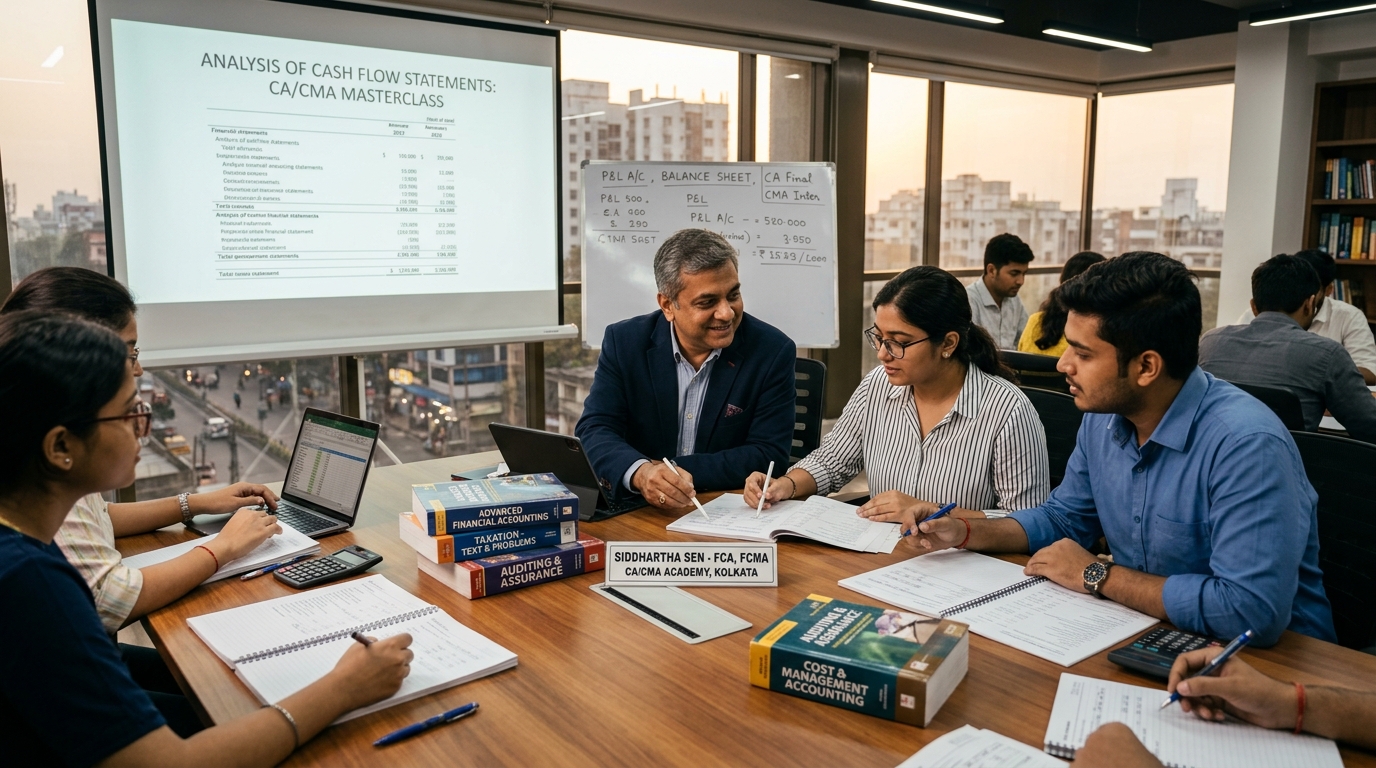
Students preparing for Chartered Accountancy often spend a lot of time studying but still struggle with consistency, revision, practical application, and examination pressure. The problem is not always a lack of effort. In many cases, students do not have a clear preparation structure, use the same study method for every subject, or depend too heavily on lectures without giving enough time to self-study. For students searching for CA classes in Kolkata, the right academic guidance can help create a more organised path from learning concepts to applying them confidently in examinations.
The Chartered Accountancy course requires students to progress through different stages, and the learning requirement changes substantially as they move ahead. ICAI's Board of Studies provides level-wise learning support for CA Foundation, CA Intermediate, and CA Final, reflecting the different academic requirements at each stage. Students should therefore avoid treating CA preparation as one continuous coaching programme where the same teaching and study method works everywhere.
One of the most important qualities students should look for in CA classes in Kolkata is concept-based teaching. CA subjects cannot be prepared effectively through memorisation alone. Accounting requires students to understand the logic behind treatments and calculations. Law requires understanding before retention. Taxation requires conceptual knowledge together with the correct application of provisions. Costing and Financial Management require students to understand formulas rather than simply memorise them. Audit and other theory-oriented subjects require structured recall and repeated revision.
This is why good CA preparation should begin with understanding. Students should reach a stage where they can explain why a particular accounting treatment, calculation, provision, or solution is correct. Once the concept is clear, question practice becomes more meaningful and students are better prepared for questions that differ from familiar classroom examples.
For students beginning at the Foundation stage, the focus should largely remain on building strong fundamentals. Early weaknesses in Accounting, Mathematics, Law, or Economics can create difficulties later because professional-level study becomes more application-oriented as the student progresses. Foundation students should therefore use classes to develop conceptual clarity, disciplined study habits, and regular revision instead of simply trying to complete the syllabus quickly.
CA Intermediate requires a more demanding preparation system. Under the current ICAI structure, Intermediate includes Advanced Accounting, Corporate and Other Laws, Taxation, Cost and Management Accounting, Auditing and Ethics, and Financial Management and Strategic Management. These papers do not require identical preparation, so students looking for CA Intermediate classes in Kolkata should evaluate faculty and learning methodology subject by subject.
Advanced Accounting, Costing, Taxation, and Financial Management require substantial practical application. Students should not simply watch a teacher solve questions and assume that the chapter is complete. A better learning cycle is to understand the concept, follow classroom illustrations, attempt questions independently, identify mistakes, revise weak areas, and then solve again.
Theory-oriented subjects need another method. Students can understand a Law or Audit lecture perfectly but still struggle during the examination if they cannot recall and present what they have studied. A stronger approach is to understand first, organise the material into clear points, practise active recall, write important answers, and revise repeatedly.
CA Final requires an even greater level of independence. Students need advanced conceptual understanding, practical application, technical accuracy, case-based thinking, revision, and examination-oriented testing. At this stage, simply collecting more classes or study materials can actually create confusion. Students need a focused academic system that leaves enough time for independent preparation.
This difference between Foundation, Intermediate, and Final is one reason students searching for CA coaching classes in Kolkata should identify their exact requirement before choosing a course. A broad promise of CA coaching is less useful than knowing which subject is taught, who teaches it, what examination level it covers, how practice is handled, and what kind of revision support is available.
Faculty selection also matters significantly. Students should not choose a class only because an institute is popular. One faculty's teaching style may suit a student very well while another student's learning preferences may be completely different. The more practical approach is to evaluate subject knowledge, conceptual explanation, pace, question-solving approach, and whether the teaching helps the student become increasingly independent.
Practice is another important part of CA preparation that students often underestimate. Watching lectures creates familiarity, but examinations test whether students can work without the faculty beside them. After learning a topic, students should close their notes and attempt relevant questions or recall theory independently.
A useful learning formula is
Learn → Practise → Review Mistakes → Revise → Test
This applies across different stages of the CA course, although the exact type of practice changes according to the subject.
Revision is equally important. Students often continue attending new classes for months without systematically revisiting earlier topics. By the time the syllabus is finished, the first chapters may already feel unfamiliar. This creates unnecessary pressure before the examination.
A better preparation system includes revision while classes are still continuing. Students can maintain weekly revision, cumulative revision after several chapters, and a more focused final revision closer to the examination. Difficult questions and repeated mistakes should receive more attention than topics that are already strong.
ICAI itself provides structured learning, live and recorded classes, revision support, and other academic resources across Foundation, Intermediate, and Final levels. Students should therefore remain connected with official ICAI resources even when attending private coaching. Coaching and official material should complement each other rather than operate as completely separate preparation systems.
Another important decision is whether to choose online or offline CA classes in Kolkata. Offline classes can provide fixed schedules, face-to-face interaction, classroom discipline, and a dedicated learning environment. Online and recorded classes can offer greater flexibility and reduce commuting time. Neither mode is automatically better.
Students who regularly postpone recorded lectures may benefit from a scheduled live or classroom environment. Students who attend college, have work commitments, or spend too much time travelling may find online learning more practical. The correct mode depends on the student's actual routine and discipline rather than what appears most convenient initially.
Location matters particularly for classroom students. Searches for CA classes near CR Avenue, Chittaranjan Avenue, MG Road, Girish Park, Central Kolkata, or North Kolkata reflect a practical concern: commuting consumes time that could otherwise be used for practice and revision.
However, students should not select coaching only because it is nearby. A more useful priority is:
Faculty → Subject Relevance → Teaching Quality → Practice → Revision → Doubt Support → Learning Mode → Location
A convenient class is useful only when the academic system also matches the student's requirements.
Students should also be careful with searches such as best CA classes in Kolkata. There is no single class that is automatically best for every CA student. The right choice depends on the student's level, subject, faculty preference, preparation schedule, learning mode, and academic weaknesses.
Instead of depending on the word "best", students should ask more useful questions. Does the faculty explain concepts clearly? Is the course relevant to the student's examination stage? Is sufficient practice included? Can doubts be clarified? Is revision planned? Does the timetable leave enough time for self-study? These questions give a much more realistic picture of course quality.
Fees are another important consideration. Students searching for CA classes fees in Kolkata should compare the complete academic offering rather than only the amount displayed during enrolment. Faculty, subject, learning mode, course validity, study material, revision support, doubt support, and examination relevance can all affect the value of a course.
The cheapest course may not be the most useful if a student later needs another faculty because the teaching style does not suit them. At the same time, a higher price does not automatically guarantee stronger teaching. Students should compare academic value rather than assuming that cost and quality always move together.
Students should also avoid collecting too many courses and books. It is common for CA students to feel that they need one more teacher, one more set of notes, or one more revision resource. This can eventually reduce the time available to properly revise the material already collected. A limited set of dependable resources used repeatedly is usually more practical than a large collection that remains incomplete.
Testing should also be included in the preparation system. ICAI continues to organise Mock Test Papers, revision programmes, and examination-support initiatives for different CA levels and attempts. For example, ICAI has announced Mock Test Papers and examination-support sessions for CA Intermediate students appearing in September 2026. Testing helps students identify whether their knowledge can actually be applied under examination conditions.
A student may know a concept but solve too slowly. Another may understand a theory chapter but fail to recall important points while writing. A third may lose marks because of repeated calculation errors. These problems become visible through testing and cannot always be identified simply by attending more classes.
Self-study remains the most important link between coaching and examination performance. Faculty can explain concepts, provide direction, clarify difficult questions, and suggest revision strategies. Students still need to practise, revise, test, and correct their own weaknesses.
Students exploring Abhimanyyu Agarrwal Classes while searching for CA classes in Kolkata can review the official website, faculty section, free resources, blog content, and current course information before deciding. The specific CA level, subject, faculty, learning mode, batch, fees, and examination-attempt applicability should be confirmed directly rather than assumed from broad search results.
This is particularly important because a website may specialise more strongly in certain CA subjects or levels than others. Students should select the course based on the actual academic offering available for their requirement rather than expecting every CA subject to be offered under one programme.
A strong CA preparation system should ultimately create progress in four areas: understanding, application, revision, and independent performance. Students should become less dependent on faculty solutions over time and more capable of identifying concepts, solving questions, recalling theory, and correcting mistakes on their own.
Conclusion:
Students searching for CA classes in Kolkata should focus on finding structured academic guidance that matches their exact stage, subject, and learning requirements. CA Foundation students need strong fundamentals, CA Intermediate students need deeper application and subject-specific preparation, while CA Final students require advanced understanding, revision, testing, and greater academic independence. Students should compare faculty, conceptual teaching, question practice, revision support, doubt resolution, online or offline learning mode, location, and fees before enrolling. Those considering Abhimanyyu Agarrwal Classes can review the official faculty, learning resources, blog, and current course information and confirm the specific CA offering directly. The right CA classes should not simply help students complete lectures; they should help them build a disciplined system to understand concepts, practise independently, revise consistently, and prepare with greater confidence for professional examinations.
Free CA & CMA 2026 Revision Strategy Kit
Download comprehensive chapter-wise formula sheets, accounting adjustments checklists, RTP & MTP solutions, and past ranker answer copies prepared by CA CMA Abhimanyyu Agarrwal.